
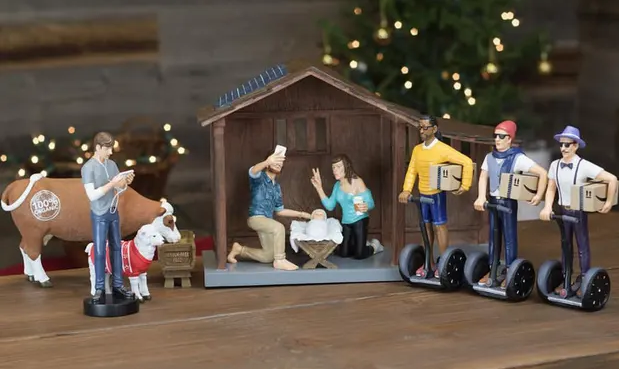
Dave Ruins (and Saves) Christmas
This post is going to upset a few people. It could shatter a billion-dollar Christmas decorating industry. And it makes me sad because a lot of the memories I have as a child are filled with lies.
Much like the lead in one of my daughter’s favorite shows (Adam Ruins Everything), today, for many people, Dave is going to ruin Christmas.
What are some common images we think about when we think of the Christmas story? No room at the inn, Jesus being born in a barn, three kings bringing gifts… My childhood was full of this imagery. Our church (like most) used to pull out a wooden structure every Christmas season, and place large, resin figures in it in an attempt to recreate the scene of Jesus’ birth. We would travel around the area to various churches to watch them recreate the story on stage.
The problem is that a lot of this imagery (at least the timeline) is wrong.
I want to get started by going through the passages that tell of the birth of Jesus. Jesus’ birth narrative appears in Matthew and in Luke, and both give us different pieces of the puzzle. The chronological order of the birth event starts in Matthew 1:18-25, then goes to Luke 2:1-21, and then Matthew 2:1-12. I won’t repost them here, but I advise you to read the passages and then come back.
When was Jesus Born?

We don’t really know. We don’t have a record of when we started celebrating Jesus’ birth. Nor the exact date of his birth. Our best guess on the year he was born puts it somewhere between 6 BC and 3 BC.
As for the date we celebrate Jesus’ birth, there are several possibilities why we do it on Dec 25th. There was a Jewish tradition that said that a prophet would die on the day he was conceived. So, because he died on Passover (March 25th) – which would have been his date of conception according to this tradition, 9 months after March 25th would have been December 25th. So, this is one possibility for the selection of the date.
Another thought has a more symbolic meaning to it. This is the time of the winter solstice, so that means the days are getting longer. That means there is more light in the world starting after the winter solstice. So the tradition says that the birth of Jesus symbolizes that the days are now getting longer and hope has begun, sort of things.
We’ll get more into the birth of the Christmas tradition later. For now, we’re just doing a good ‘ol Bible study.
Is Christmas Celebrated In The Bible?
No. Christmas, as we know it, does not occur in the Bible. But, the event that Christmas represents IS in the Bible – the birth of Jesus. And lots of people celebrated it. This was the moment that God became flesh (John 1:1) – that God came to dwell amongst us. And, as we read earlier, with the coming of the shepherds and the appearance of the heavenly host and the coming of the wise men, it was something that was celebrated. Just not like what we think of it as. And it isn’t commanded of us to celebrate Jesus’ birth, either. There is no prescription for it. But his coming gave a lot of people a cause to celebrate very early on.
Where Was Jesus Born?

This Christmas season, thousands of churches across the US will put on live reenactments of the Nativity scene on stage. They will portray Joseph and Mary riding into Bethlehem at night while she is in labor. The Innkeeper will tell them he has no room, but they can shack up with the livestock in the barn-like structure. Jesus will be born in a feeding trough surrounded by shepherds, singing angels, and three Asian kings. Millions of houses will display this scene in various artistic representations, too.
Now, here comes the …ruins Christmas part. Because it probably didn’t look like that.
First, let’s talk about Joseph and Mary’s journey to Bethlehem. I think sometimes we tend to do this thing called timeline compression in our heads when we hear a story, and by that I mean we tend to visualize events happening in rapid succession when really they happened over the course of several days. The journey from Nazareth to Bethlehem is about 65 miles. There were no freeways back then, so you had to walk it. It would probably take Joseph and his very pregnant wife riding on a donkey about 4-5 days to walk the distance.
One tradition of the day (which is still very strong in Middle Eastern culture) was to have room for guests and travelers, should they need a place to stay. These people are still very welcoming. The residents of Bethlehem would have had guest rooms available for out-of-towners to stay in when they traveled. Not only were Joseph and Mary heading to Bethlehem, but so were all of the other Jews of the house of David. They were headed to Bethlehem because of the census. So the little town of Bethlehem would have been bursting at the seams with out-of-towners like Mary and Joseph.
Was There Really No Room In The Inn?
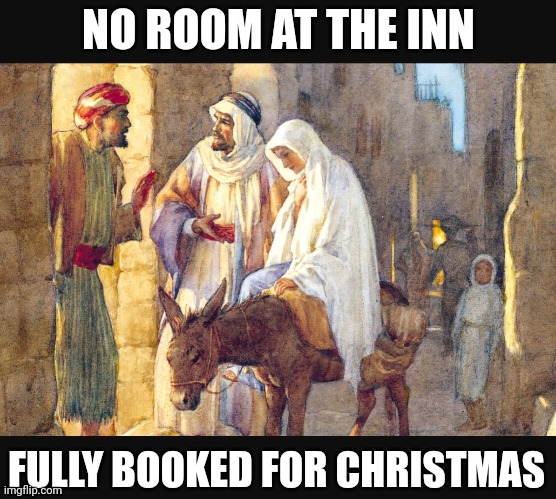
Now, let’s talk about this place where Joseph and Mary asked for a room. If you look next to the word “Inn” in your Bible, there is probably a footnote. If you look down at the footnote, what does it say? Mine says “or guest room”. The word that gets translated as “Inn” is the Greek word “katalyma”. It appears 3 times in the New Testament – here in Luke 2:7, and also in Luke 22:11 and Mark 14:14.
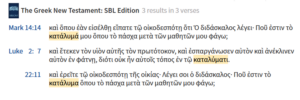
Both of these verses are when Jesus enters Jerusalem and tells the disciples to go find them a guest room (this can also be translated as “upper room) to hold the Passover feast.
Chances are, Joseph (and Mary, because she was also of the house of David) had family in Bethlehem. So, they would have gone to their homes first, seeking a guest room. They may have looked for lodgings in other people’s houses in THEIR guest rooms, too. It’s not clear. But, it wouldn’t have been the manager of a Holiday Inn that said “no vacancy” – it would have most likely been people’s homes they were looking to stay in. So – Innkeeper saying no room? Myth Busted
The next thing I want to talk about is the structure in which Jesus was born. Most nativity sets will have the couple staying in a wooden stable or barn of some kind. This is likely false as well. Let’s have a look at a 1st century Middle Eastern Home

The house would have had 3 levels. If you notice, there is a ladder leading to the roof. This would have been the guest room or the upper room, it is frequently called for obvious reasons. Guests would have slept on the roof because it would have been the coolest place in the house. They would have hung linens and drapes here for privacy, but the breeze would have flowed nicely here to keep the guests comfortable.
The middle section would have been the main living quarters where the family slept. Notice, there is a lower section. This would have been the main working area of the house during the day and the place they would have brought in their valuable livestock at night. Obviously, no room for herds of sheep. But, they would have brought in their working animals – their donkey (for pulling and carrying), possibly a goat and/or sheep (for milking and shearing of wool for clothes), and maybe their animal for sacrifice at the temple. So, the animals would have slept in the lower part of the house with the residents and not in a barn or stable. It’s this lower part of the house where Joseph and Mary likely stayed because no one they asked had any guest rooms available. So, Jesus being born in a barn? Another myth busted
Who Came To The Party?
Now, let’s have a look at who came to see Jesus and when. First to arrive were the shepherds. On the same day Jesus was born, an angel appeared to them and announced that the Savior had been born. The heavenly host appeared, glorified God, and then left the shepherds in the fields. After the angels left, the shepherds went into Bethlehem, found Jesus, and glorified God. The shepherds, however, were NOT there when Jesus was born. They showed up a little afterwards and then left.
So who came next? The famous Christmas carol has labeled these people as “three kings”, but the Greek word here is magi, which more properly is translated as “wise men”. These would have been advisors to kings, but not kings themselves. They were men whom kings consulted with on matters of policy, culture, law, star charts, etc.
How many were there? We always picture 3 because there were three gifts. But the text never specifies exactly how many there were. Likely, it was an entire caravan of people. More like dozens, not three, on the banks of camels.
We don’t know exactly where they came from except “from the east”. We can tell a few things about them based on the things they said and did. First, they saw a start and recognized that it was the sign of a coming king. And, not just any king. These guys would have worked for lots of kings. But the particular sign showed them a king that they should come from afar and worship. These men were likely not Jews, but they would have been very familiar with the Jewish Scriptures and prophecies. And not just familiar; convinced that the king being born was one worthy of traveling a long journey – at great expense, no doubt – to see in person and worship.
One theory about their origins is that they came from Babylon. Daniel had been captive there 500 years before Jesus’ birth. Nebuchadnezzar saw the wisdom Daniel possessed and made him a high-ranking official and trusted sage. So, Daniel probably told the Babylonians all about Yahweh and the prophecies he was given. It was this tradition that the magi who visited Jesus had probably been handed down.
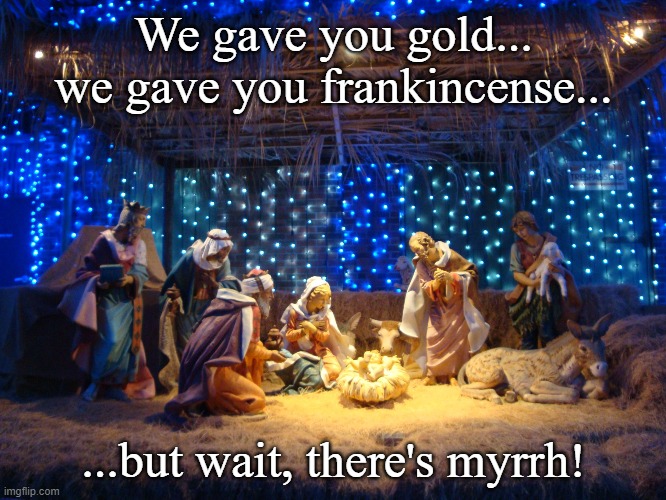
What about the gifts they brought? Well, the reasons for the gifts range from highly practical to possibly symbolic. I tread cautiously into the symbolic because we have to be careful when implying intent that is not stated outright. On the practical level, these gifts were very valuable. The gift of gold is obvious – having a baby is expensive! Frankincense was used for a variety of reasons – it was used for incense, perfume, some cultures used it for medicinal purposes, and it was also used during worship. Myrrh also has many uses – in perfumes, in medicines for digestive issues, for purification, and for embalming.
The practical uses for a new mother and her baby are obvious. But, it’s also possible that these gifts had a more symbolic meaning that ties into the three offices of Christ. First, we have the gold. Gold is something given to a king. Jesus is the king of Heaven. So, this is a gift befitting a king. Frankincense was used by the high priest and burned in the Temple as a pleasing aroma to the Lord. Jesus also occupies the role for us as high priest – the one who intercedes on our behalf. And, finally, we have myrrh. One of its uses is for embalming. Was this a gift predictive of his fate? Possibly.
These could have been symbolic gifts. But I want to be careful not to go all in and say yes, absolutely, that is why these gifts were given, without digging into it a little more.
When did they come? Well, I would say that they certainly weren’t there when Jesus was born. Nor were they there a few days later, like most nativity scenes portray. The star appeared when Jesus was born. That’s when they would have begun their journey. Also, the language describing Jesus’ age shifts slightly when the magi arrive (Matt 2:11). Jesus is no longer referred to as a babe. Now he’s called a child. Granted, this could mean he is still an infant. Also, Jesus is described as being in the house, not in the manger. So, wherever Joseph and Mary were staying, some room had freed up, and they weren’t shacking up with the livestock anymore. Jesus was likely at least a few months old at this point when the magi came. Maybe even a couple of years.
If we look at Matthew 2:16, Herod, realizing that the wise men had tricked him and were not coming back, decrees that all males 2 and under in Bethlehem and the surrounding region were to be killed. I doubt Herod sat there for 2 years waiting for the wise men. It was probably a few months at most. Bethlehem is only a 6-hour walk from Jerusalem, where Herod was – it wasn’t like the wise men had far to go once they spoke to Herod. So, the wise men probably visited Jesus between Years 1 and 2.

Now, let’s move on to more modern times and talk about some of the myths surrounding the holiday we call Christmas. Because even though I might have ruined some of the imagery, there are some parts of the holiday that need saving.
Is Christmas Pagan In Origin?
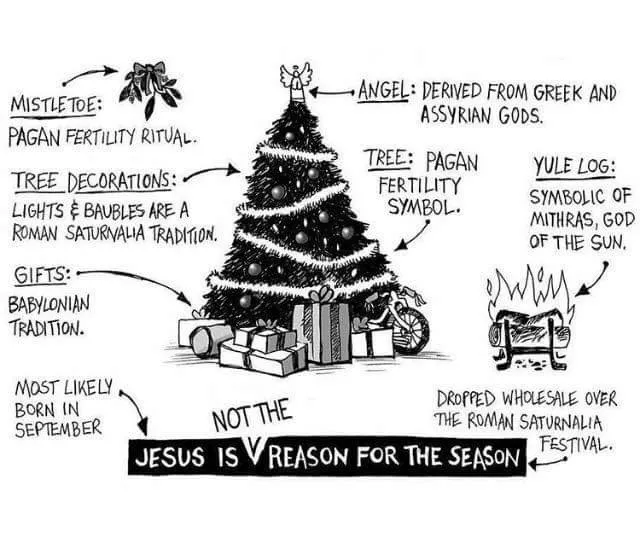
One common challenge – from both non-Christians and Christians alike lately – is that Christmas is based on a pagan holiday and incorporates pagan practices. Nonbelievers will say this in a somewhat smearing and mocking manner. And Christians will levy this against other Christians who want to celebrate Christmas in an attempt to accuse them of being pagans. This is as if to say that putting up a Christmas tree on and gathering on Dec 25th is some form of pagan worship. And, Christmas isn’t Christian at all.
So, what pagan events do people bring up as being the same day as Christmas? Well, we have several birthdays and holidays that get mentioned. The three most popular are the birthday of Mithras, the pagan holiday Saturnalia, the birth of “Sol Invictus”, and the birthdays of Dionysus and Horus. These are brought up to somehow try to show that Jesus is a copy of other pagan deities.
On a side note, just because one historical account looks very similar to another historical account (or legend or myth or whatever) doesn’t mean the first one is false. For example, in 1898, Morgan Robertson first published a story called Futility (later republished as The Wreck Of The Titan). The story is about a fictitious American ocean liner, considered a marvel of engineering, named Titan. This ocean liner sinks in the Atlantic Ocean after it strikes an iceberg. Sound familiar? The historical Titanic hit an iceberg in the Atlantic in 1912, 14 years after the book was written. Now I ask you, does the earlier fictitious story discount the historical event of the actual sinking of the Titanic? Of course not. When studying a historical event, we have to evaluate the truthfulness of the accounts based on the evidence of that account. Whether there are similarities between it and other stories is irrelevant.
When you try to research the ancient pagan holidays and birthdays, what you find is a bunch of modern sources that quote each other and never quote historical sources. Most of these sources were written or filmed in the past 20 years. And, the oldest sources they may draw from are books written in the late 1800s that were debunked pretty handily in the early 20th century. There is never any real scholarship to these claims.
For these deities, you’ll hear claims like (in the case of Mithra) that they were born of a virgin, they were born on Dec 25th, they had 12 followers, they performed miracles, they died and came back to life, and they were worshiped on Sunday. We’ll definitely look at these individual claims later in future articles, but for now, let’s just say that most of these claims of similarity with Jesus are just false. And, the ones that seem to be true are pretty generic in their assertions. In other words, there are no records that indicate that Mithras nor Horus nor Dionysus were born on December 25th.
Saturnalia
So what about the other holidays? One holiday that gets mentioned in the same breath as Christmas is the Roman celebration of Saturnalia. This was a celebration that occurred Dec 17-23 (so not even the same day), where people would go through the streets and from house to house singing. I mean, that kind of sounds like caroling, right? Except they did it naked.
Also, singing in the streets isn’t specifically a pagan practice. Just because someone does something similar to another people group doesn’t mean they are the same as that other people group. It’s the intent of the thing that matters.
During Saturnalia, there would also be human sacrifices. Supposedly, the masters would serve the slaves as a reversal of roles, but it was more in a mocking manner. There was also drunkenness, rape, and sexual immorality. So, this sounds EXACTLY like what Christians think of when they celebrate Christmas, doesn’t it?
Sol Invictus
Next, we have the Roman celebration of “Sol Invictus” that supposedly happened on Dec 25th. We aren’t sure what this celebration actually was. The first reference to it is very vague. And the first reference is in the same 4th-century document that gives Dec 25th as Jesus’ birthday. So, from that document, we can’t tell which one came first.
Earlier, we talked about a couple of reasons why the church might have started celebrating Jesus’ birthday on December 25th. Honestly, it most certainly could have been to repurpose pagan holidays. Is this a problem, though? Not really.
Imagine if your birthday fell on one of the solstices – when many pagan rituals were historically performed. Or what if you were born on Sept 11th? Does that mean we shouldn’t celebrate your birthday? No, of course not. Even if some of the pagan birthdays and holidays really did used to occur on Dec 25th, nobody remembers it. Most people have no idea who Horus or Mithras were. No one has heard of Saturnalia or Sol Invictus. Everyone thinks of Dec 25th as Jesus’ birthday now. So we won.
Is It Biblically Acceptable To Celebrate Holidays?
The Jews of the Old Testament certainly did. God prescribed for them several holidays that they were to celebrate. They were still celebrating them in Jesus’ day. But what about holidays that are not proscribed in the Bible? There is no direct command to celebrate Jesus’ birth. So, is it OK to do so?
Well, we have evidence of Jesus taking part in celebrations that are not commanded by God. In John 10:22, the Jews were celebrating the Feast of Dedication (Hanukkah), and Jesus was there with them. Hanukkah isn’t in the Old Testament. It didn’t start until the 1st century BC. And yet, Jesus seems to be fine with the festivities.
In Romans 10:5-6, Paul says this:
5 One person esteems one day as better than another, while another esteems all days alike. Each one should be fully convinced in his own mind. 6 The one who observes the day, observes it in honor of the Lord. The one who eats, eats in honor of the Lord, since he gives thanks to God, while the one who abstains, abstains in honor of the Lord and gives thanks to God.
In other words, if you want to celebrate something and I don’t want to celebrate something, it doesn’t matter if we are both doing it in honor of God. So, there is nothing wrong with celebrating Jesus’s birthday. But you also don’t have to if you have some sort of moral quandary with the whole thing. There is no command one way or the other, so it’s up to you.
Are Christmas Trees A Pagan Symbol?
A common charge is that putting a tree in your house and decorating it with lights and trinkets is a pagan custom. One commonly cited source of origin of this practice is the Roman Cult of Asheira, whose members would put trees in their homes and decorate them. Supposedly. The only place you can really find claims that the Christmas tree is a pagan symbol is on sites on the internet that offer no source citations. When you search for actual historical sources, you find nothing. Think we are safe to dismiss this notion that Christmas trees are pagan until we find any sources
So, where do Christmas trees really come from? We don’t have a specific source that cites the origin of the Christmas Tree tradition, but we do have one oral tradition that has some merit. One legend about the beginning of Christmas tree use is that Martin Luther was walking in the woods one evening, looked up into the sky, and saw the bright stars between the branches. He felt awe-struck and was reminded of how Jesus, the Son, descended to Earth to be our savior. So, he cut down a tree, took it into his home, and put lights on it, just like we do now. Except they were candles.
This legend has some merit because Christmas trees were a solely German practice until the 1800s.
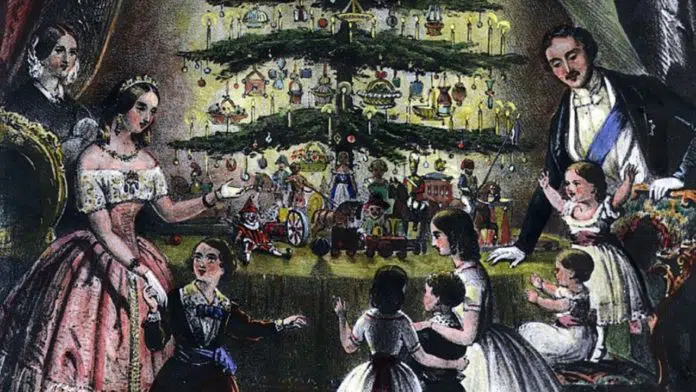
So, how did the tradition spread past Germany? The British royal family popularized it in the mid-1840s when Prince Albert (who had German ancestors) imported several spruce trees from Germany and put them in the palace. By this time, putting a tree in your house wasn’t uncommon, but what happened is that periodicals started publishing drawings of the Royal family standing around their Christmas tree year after year. And, because the royal family was like a bunch of celebrities, the British people followed suit.
Let’s ask ourselves some questions about trees to try and gain clarity on the issue. Is there anything pagan about trees? Did God call upon he pagan deities on Day 4 and say, “Hey, you guys make some trees. Those are yours”? Not so much. Is there anything pagan about putting a tree in your house? If you cut down a tree outside, is paganism somehow suddenly imbued into it when it crosses through your doorway? No. People put plants in their houses all the time. Is there anything pagan about decorating a tree? Barren tree in the living room – fine. Add some lights – POOF! Satan. No.
If this cult of Asheira really did put trees in their house, decorate them, and use them for pagan worship, then the only thing pagan about the whole process was their intent. Their purpose. It is the purpose of the action that matters, not the action itself. Because if we are not allowed to do things that pagans do in church, then we can’t sing in church either.
So, then, we need to ask ourselves what the purpose of putting a Christmas Tree in our homes is? Well, for me, it’s fun. It looks really nice. And, if you get a live tree, it smells really nice. And maybe it is symbolic to you. But it’s only symbolic if you make it symbolic. And even then, the part that matters is what it symbolizes to you
So, is Christmas pagan? No. There is no threat of ancient paganism in Christmas celebrations. However, Christmas is threatened by something else, and that’s modern secularism. Now, I’m not suggesting there is some sort of conspiracy or anything; just that it is the times we live in now.
Secularism is indifference to or rejection or exclusion of religion or religious considerations. For example, Christmas gatherings now are little more than events to swap gifts, eat, drink, and be merry. Most Hanukkah parties are like this as well. When the broad culture takes the religious purpose out of the holiday, then it has become secularized.
And no other figure has done more to secularize Christmas… than Santa Claus.
Here Comes Santa Claus
Now, I admit, I’m being a little cheeky here. I’m not suggesting Santa Claus is some evil conspiracy propped up to remove Jesus from Christmas. But if a single figure dominates the Christmas scene, it is Santa Claus.
So, where does Santa Claus come from? Again, we don’t have a lot of sources for his origin. And, Santa Claus has kind of morphed over time from one thing into another as other cultures add their little spin on him. Primarily, Santa Claus is based on St. Nicholas – a historical figure – and Father Christmas – a mythical one.
Saint Nicholas was the Bishop of Myra in the 300s AD. There are many legends that have developed about him over time. One legend regarding St Nicholas is that he inherited a large fortune when his parents died. And he gave it all away. He did this without expecting anything in return. And, if you think about it, this is something that Christ preached. If you have plenty, and there are people in need, you should help them out.
One particular story revolving around St. Nick has him dropping a bag of gold through the window of a house where three girls lived with their mother. And he supposedly did this to save them from a life of prostitution. Now, this tale takes on several very different spins, though. On the other end of the spectrum the story goes that the girls had been beheaded and pickled by some nefarious fellow, and St. Nicholas resurrected them.
The name “Santa Claus” comes from “Sinterklaas” which is the Dutch translation of his name. But, as I said, this figure of Santa Claus has morphed quite a bit over time from the image of a 300 AD priest to what we have now. Modern Santa Claus draws heavily from Dutch, American, Norse, and German cultures. The idea of Santa Claus has been around for a very long time. He was around during Martin Luther’s time (in the mid-1500s), and Luther didn’t like the idea of this obsession with St. Nick because it distracted people from the Christ Child. How predictive of him…
Santa Claus began to morph from the idea of St. Nichalaus into what we visualize as Santa today in the early 1800s with the famous poem Twas the Night Before Christmas. This is when the idea of him being an elf started (a right jolly old elf). Also in 1931, Coca-Cola started running ads of Santa drinking Coca-Cola. Before then, there were many different images of Santa – from a tall, gaunt figure to a short and fat man. Also, Santa wears different colors depending on which country you are in. But Coca-Cola’s colors are red and white. So… Santa’s colors became red and white here. That image is now ingrained into the American psyche of what Santa wears. And, as the West goes, so goes the rest of the world.
Can Christians Celebrate Christmas?
Yes. Feel free to put up trees, hang lights, and sing Christmas carols. Or don’t. It doesn’t matter. What matters is the meaning behind the things you are doing. Or not doing.
What Is The Reason For The Season?
The answer is given right in Jesus’ very name. Jesus is the Greek form of Joshua. The name in Hebrew is Jeshua, which means “God our salvation”. In Matthew 2:21, the angel tells Joseph, “You shall call his name Jesus, for he will save his people from” what? Not from the oppressive Roman government, not from the patriarchy, not to fix our problems, not to bring families together, not to make the world a better place right now, not to vanquish all iniquities in this lifetime. but “he will save his people from their sins”. This was his mission all along: to bring people into a right relationship with God.
This is the reason for the season. To celebrate the fact that God initiated a rescue plan for us. On a day over 2000 years ago, the Author entered the story. Because he loves us and wants us to spend eternity with him.
Share This Story, Choose Your Platform!
About the Author: David W. Gilmore


latest video

news via inbox
Subscribe and never miss an update!