
Christianity Criticisms: “Even Christians Don’t Follow The WHOLE Bible”
Should Christians follow the whole Bible? Are we supposed to follow all of the commands God has given? Are Christians hypocrites if they don’t do everything the Bible says?
Understanding the Bible can be hard. I’m going to offer you two tips that will help you resolve challenges like this one.
Should Christians Follow The Whole Bible?
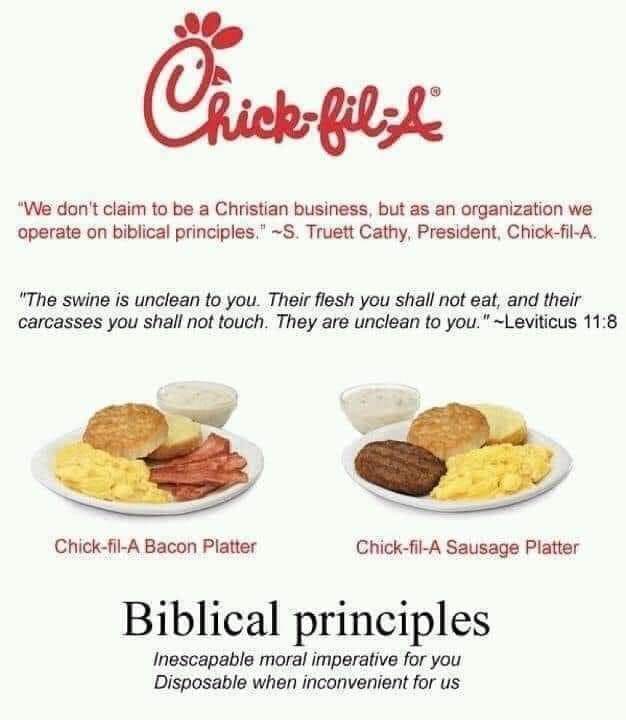
You may have come across challenges like this before. The challenge usually cites a verse from the Bible (typically the Old Testament) having to do with dietary laws (like this one does) or clothing restrictions or other cultural practices that Christians clearly do not follow today. This line of reasoning is usually brought up when Christians make the case against certain cultural practices, most popularly same-sex relationships. Chick-Fil-A came out on the side of traditional marriage and caught a lot of heat for it. The person posting this meme is saying, “Look, you tell us to follow the rules in the Bible, but you clearly don’t follow all the rules. So why should we listen to you on the topic of homosexuality, hypocrite?”
Is this true? Are Christians hypocrites for not following these laws? Are we supposed to not eat pork or not mix two different fabrics? Or should we let go of some of the traditional values Christianity has had for 2000 years, just like we have let go of many others?
The question at the root of this is how Christians determine which rules apply to them now and which do not. Let’s go over a few guidelines you can use to figure this out.
Where Is The Passage From?
First, keep in mind that there are two major parts to the Bible – the Old Testament and the New Testament. Testament means “covenant, agreement, contract”. Most of the verses used in this type of argument come from the Old Testament. The Old Testament was the covenant that God had with the nation of Israel. God’s plan for the nation of Israel included setting them apart from the pagan practices of the nations that surrounded them. He put laws in place that would keep them pure and holy.
When you read through the Old Testament laws, and you come across some weird requirement about food, the restriction was often given because God didn’t want them to adopt practices of the pagan nations around them. For example, the Caananites would keep large herds of swine specifically for the practice of sacrificing to idols. God did not want the Israelites to go anywhere near that practice. So, he told them to stay away from hogs altogether.
There would have also been health considerations. Undercooking certain meats can make people sick. And pork needs to be cooked more thoroughly than things like beef or chicken. When Israel was being formed, there was no knowledge of microbial pathogens. Also, eating uncooked meat was a common thing in many cultures. And, this was God’s way of saying, “Don’t eat that. It will make you sick”.
What Does The New Testament Say About This?
The second thing to do when evaluating Old Testament laws is to look for any commentary about them in the New Testament. The New Testament (or covenant or agreement) is God’s promises to the entire world, should they choose to come under the Lordship of Jesus Christ. So, if Jesus or one of the apostles wrote something about a specific issue (in this case, dietary requirements), then it takes precedence over the Old Testament.
For this specific issue, Jesus had this to say:
14 And he called the people to him again and said to them, “Hear me, all of you, and understand: 15 There is nothing outside a person that by going into him can defile him, but the things that come out of a person are what defile him.” 17 And when he had entered the house and left the people, his disciples asked him about the parable. 18 And he said to them, “Then are you also without understanding? Do you not see that whatever goes into a person from outside cannot defile him, 19 since it enters not his heart but his stomach, and is expelled?” (Thus he declared all foods clean.) 20 And he said, “What comes out of a person is what defiles him. 21 For from within, out of the heart of man, come evil thoughts, sexual immorality, theft, murder, adultery, 22 coveting, wickedness, deceit, sensuality, envy, slander, pride, foolishness. 23 All these evil things come from within, and they defile a person.”
Mark 7:14–23 (ESV)
In verse 19, Jesus declares all food to be clean. So, to answer our question, the dietary restrictions placed on the Israelites do not apply to Christians. Also, notice why that is. Jesus says that eating the food in and of itself wasn’t the issue; the issue was the external activity associated with the food. Jesus said, “You can eat whatever you want. It’s your heart and your actions I’m focused on”.
Another place this declaration gets made is in Acts 10:9-16. Peter is staying at a house, and he goes up on the roof to pray. He has a vision of animals coming down on a sheet. God tells Peter to kill and eat the food. But many of these animals had been declared unclean by the Law. When Peter tells God he can’t eat unclean food, God tells him, “What God has made clean, do not call common”. In other words, it’s OK now.
This Meme Is Self-Defeating
The number one reason that this type of argument is used against Christians has to do with sexual ethics. Ironically, when someone makes this move, they are unknowingly agreeing with the Christian that the Bible forbids (or at least has something to say against) same-sex activity. Because the argument here is “the Bible has this rule against same-sex relationships. It also has this rule against eating pork. You don’t follow the rule about eating pork, so why should you follow the rule about same-sex relationships?” Notice that embedded in the argument is the admission that the Bible does forbid this activity. Otherwise, the person making the argument wouldn’t have anything else within the Bible to make the comparison to.
No Hypocrisy Here
Are Christians hypocrites for not following every single law in the Bible? No. As we’ve demonstrated, where the passage is located makes a difference. If it’s in the Old Testament, then ask yourself if Jesus had anything to say about this issue in the Gospels. The burden of the Law of the Old Testament does not apply to Christians. We have been freed from the Law by the sacrifice Christ made for us on the cross.
Share This Story, Choose Your Platform!
About the Author: David W. Gilmore


latest video

news via inbox
Subscribe and never miss an update!

I agree, many things can be taken out of context and it can spread misinformation too.
Hi No,
Thank you for your comment. I agree; it is important that we consider the context in which things were written or said
i agree with this article i think that people love to attact christians without doing there research and it tends to make it seems that christians are hypocritical but that is not the truth in most cases
Thank you for your comment. I agree that the standard is often applied to Christians in ways people would not apply it to people they agree with. It should be a reminder to us that we need to be sure we’re not being hypocrites in the things we say and do so we can represent Jesus well.
The old laws have been either established or abolished in the new testament
HI James,
Absolutely. Thanks for your comment
i think that the bible was written to talk about how a human can be perfect, the best they can be. no one in this world is perfect, everyone who is a christian does their best to follow every step in the bible, but no one will be able to take every step perfectly.
Hi Arman,
I agree that the Bible gives us the blueprint of what it means to live the perfect life. It also shows us how hard that is and why we need help!
Thanks for your comment
i disagree not every christian is perfect and some still have old habits that they need to break
Hi DJ,
Absolutely!
Thanks for your comment
Christians abide by some of the Old Testament laws, but most of the commandments we follow are from the New Testament.
Hi John,
Good observation. Whenever there is a point of conflict, we go by the New Testament.
THanks for your comment
I noticed how the new testaments rules and statements over ride ones from the old testament, making things that the old testament says not apply to us in our current day. This does not make the old testament invalid, because it shows us how God operated back in the day and how things were before Jesus came about. The contradictions that people attempt to explain throughout the bible mostly are because of this.
Hi Deacon,
You’re right. Often people lump both parts of the Bible togather and do not understand that they represent two different agreements that GOd has made with different people
THanks for your comment
how interesting it is to see how things change and affect today’s world.
HI Kaeley,
Much of the laws and rules that form our societies today are taken from the Bible
Thanks for your comment
I really appreciate how this post broke down the argument into it’s parts and laid out clearly as well as respectfully how the meme in this case as well as the overarching argument from those who oppose christianity are wrong.
Hi Micah,
THqanks for your thoughts!
Christians a definitely not hypocrites when it comes to eating meat. After breaking the Bible down we have come to a conclusion that God wasn’t saying to never eat meat, but to be careful how you eat your meat and make sure you fully cook it before consumption.
Hi Hailey,
Health concerns were certainly important. The main reason for all the restrictions was to make sure the Israelites weren’t partaking in the same pagan rituals as the people around them
Thanks for your comment
The summary of this article is that many rules in the Old Testament are not applicable to Christians anymore as the world evolved. Christians nowadays are criticized for being hypocrites because we do not necessarily follow all the rules in “the Law”, but in reality that is not how they are. Christians have been freed from the sacrifice of Christ on the cross, therefore they treat each other with love, compassion, and forgiving.
Hi Henrick,
Great summary!
Thanks for your comments
The Bible shows us how to lead a perfect life but we are aware that all Christians are not perfect. In the Bible Romans 3:23 first thing you must do to come to Christ is acknowledge you are a sinner. Amazing article!
Hi Christian,
Great observation! Christianity starts with “Man… I am MESSED UP! And I need help!”
Thanks for your comments
christianity has many metaphors to be taken serious to an extent.
Hi Wyatt,
Can you give me an example of a metaphor that you’re talking about?
Hey, this is a great article and I really like how you emphasized the importance of context and the difference between the old testament and the new testament.
Hi Elias,
Thank you. Understanding the context of a passage as well as the history of what was going on when the passage was written is key to determine the author’s meaning.
Thanks for your comment
I agree, Christians are far from hypocrites. If you look at the context of the Bible then everything becomes clear. For example, if someone comes into the middle of a conversation, they’re not going to understand the context of what’s going on unless they ask questions.
Hi Sarah,
Good observation
Thanks for your comments
I think the reasoning for this issue is because these people idolize various things and when they’re questioned, it staggers their beliefs, which in turn creates valid insecurities their lifestyle and has questions arise about, and instead of attempting to answer the questions, they target their focus at what prompted the thought to begin with and if they’re able to dismantle that person’s argument or use ad hominem arguments then discrediting everything as a whole becomes very feasible.
Hi Brayden,
Thanks for your thoughts and your comment!
Interesting how the internet shares these ideals and how some people think they understand Christianity without fully knowing.
Hi DC,
Indeed. This is why we need to make sure we are accurately speaking on and representing Christ at every opportunity.
Thanks fr your comments
I like how you state this because my non Christian friends always ask me questions like this. We should always look to the New Testament for answers
Hi Evie,
That’s right! Christians are under the new agreement/covenant with God. And, things written in the New Testament take precedent over the Old Testament for us.
I agree since Jesus Christ came and paid the ultimate sacrifice for us we do not have to follow the old testament laws.
HI HN,
There are some things from the Old Testament that we also follow. But, in cases like with food restrictions, those no longer apply.
facts I agree
Thanks, Zookey.
I believe we need to look more into the context of verses before we use them in arguments.
HI Isaac,
Understanding the context of a verse is a skill everyone should have when doing Bible study.